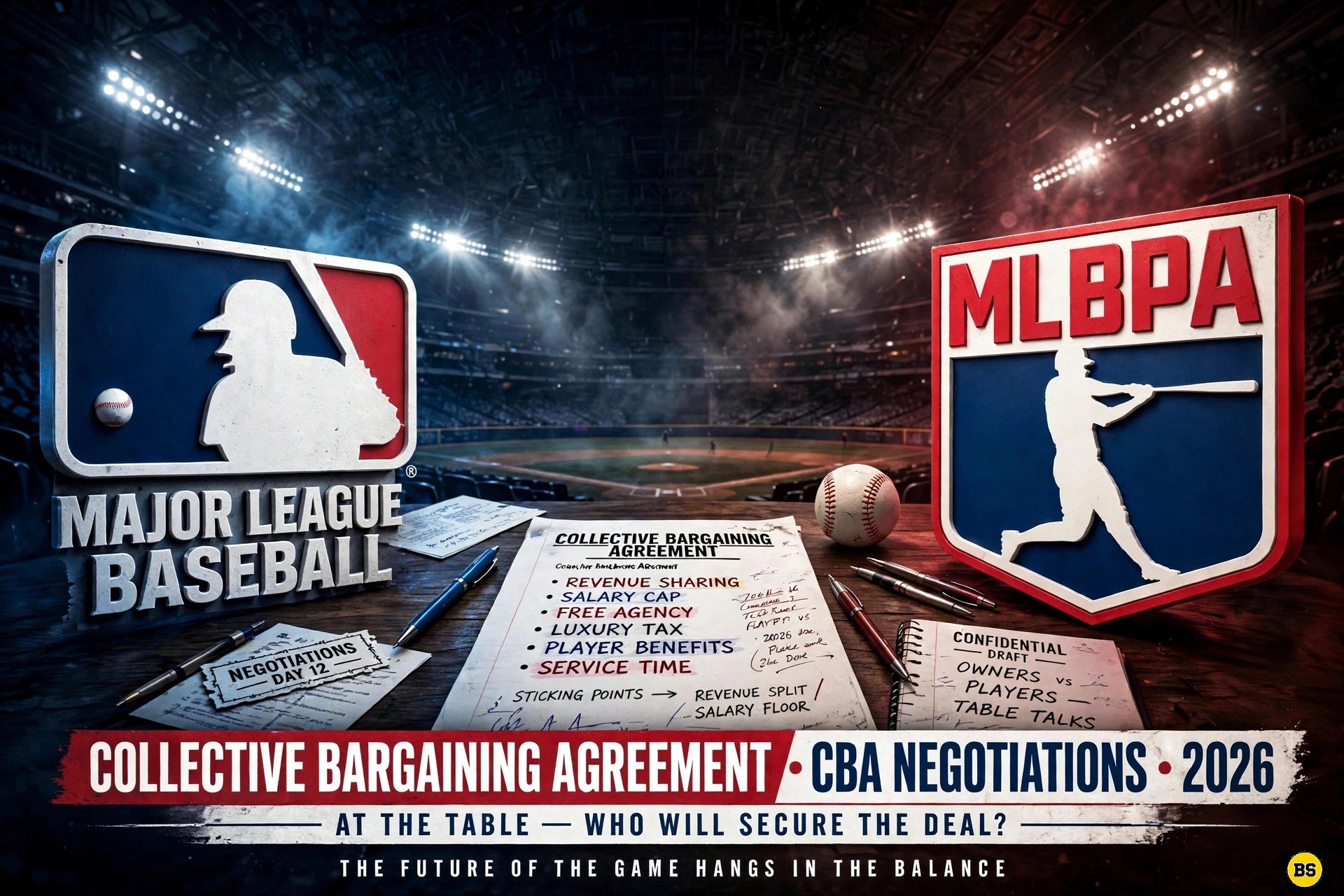

The MLB CBA and the New York Mets: How the 2026 Labor Negotiations Could Affect New York
The next MLB Collective Bargaining Agreement (CBA) could have a major impact on the Mets. Here’s what New York Mets fans need to know about the 2026 MLB CBA labor negotiations and how changes to baseball’s economic system could affect the team’s spending, roster building, free agency and future.
Major League Baseball is heading toward one of the most important labor negotiations in years.
The current MLB Collective Bargaining Agreement (CBA) between Major League Baseball and the MLB Players Association (MLBPA) expires on December 1, 2026. Both sides are negotiating the agreement that will govern the sport beyond the 2027 season. The discussions cover everything from player salaries and free agency to team spending, revenue sharing, amateur drafts and the postseason.
For casual baseball fans, the CBA can sound like a complicated collection of legal and financial terms. But at its core, the CBA determines many of the rules governing the relationship between MLB’s teams and its players.
Among the biggest disagreements in the current negotiations are whether Major League Baseball should adopt a salary cap and salary floor, how teams and players should divide baseball revenue, how much teams should be required to spend, how quickly players should reach free agency, whether MLB should create an international draft and whether changes should be made to the postseason.
This article explains what the MLB CBA is and explains the major areas of disagreement in the current negotiations.
What Is the MLB CBA?
The Major League Baseball Collective Bargaining Agreement (MLB CBA), formally called the Basic Agreement, is the negotiated accord between players and clubs that governs their working relationship, typically for about five years. It covers everything from meal allowances and travel rules to minimum salaries, free agency, revenue sharing, and roster sizes.
Baseball’s first CBA covered 1968-69 and was the first in professional sports, built by union leader Marvin Miller. Historically, the collective bargaining agreements last between 4 to 5 years. Every negotiation from 1972 through 1995 produced some form of strike or lockout, and the 1994 World Series was canceled. The current agreement was reached on March 10, 2022, after a lockout that delayed Opening Day from March 31 to April 7. That lockout lasted 99 days.
A lockout is when owners shut down operations. A strike is when players refuse to work. Owners are expected to lock players out after the agreement expires. That would freeze free agency and trades, as in 2021. Under the status quo, talks can continue without immediate change until a deal or an impasse, but the MLB owners do not want the current terms to continue.
Formal talks for the next deal began May 12, 2026. Both sides have exchanged proposals, and by nearly every account they remain far apart. Negotiations currently have no scheduled dates and are being put on an as needed basis. At the moment, everything is business as usual.
The Core Areas of Disagreement in the MLB CBA
From what I see, the major issues currently being discussed include:
(Click the link to jump to that section)
Salary Cap vs. No Cap and the Salary Floor
Revenue and Television Sharing
Player Compensation and Service Time
Below, I’ll discuss each one.


Salary Cap vs. No Cap and the Salary Floor
This is the central and most contentious issue. MLB has formally proposed a hard salary cap and floor for the first time since the lead up to the 1994–95 strike. For 2027, the league’s proposal calls for a hard cap of $245.3 million (including benefits) and a hard floor of $171.2 million, paired with a 50/50 revenue split.
Under 2026 Opening Day Competitive Balance Tax (CBT) payrolls, roughly eight high spending clubs (including the Dodgers, Mets, Yankees, and others) would need to cut spending, while about a dozen lower spending clubs would be forced to increase payrolls.
The Mets are currently one of the highest spending teams in MLB, frequently exceeding the Competitive Balance Tax (CBT) threshold to sign top-tier talent (Juan Soto, Francisco Lindor, etc).
Owners argue the current system produces extreme payroll disparity (sometimes cited as a gap exceeding $400 million between the highest and lowest spenders) that undermines competitive balance and fan hope in smaller markets. They note that no true, low revenue team has won the World Series since the 2015 Kansas City Royals and point to hard cap systems in the NFL, NBA, and NHL as models that promote parity.
The MLBPA strongly opposes a hard cap, calling it a form of collusion that limits player earning power, erodes guaranteed contracts (via potential escrow mechanisms), and gives owners an excuse not to compete. The union prefers maintaining an open market while using other tools (higher luxury tax thresholds, a “competitive integrity tax” on low spenders, and enhanced revenue sharing) to address imbalance.
Union proposals have included raising the minimum salary dramatically (to as high as $1.5 million) and creating incentives for teams to spend rather than imposing rigid limits. Players have publicly signaled willingness to endure a long lockout rather than accept a hard cap.
Luxury Tax and Team Spending
Under the current CBA, MLB uses a soft cap luxury tax (Competitive Balance Tax) rather than a hard ceiling. The 2026 base threshold is $244 million. Teams exceeding it pay escalating taxes: 20% for the first year over, 30% for the second consecutive year, and 50% for three or more consecutive years.
Additional surcharges apply at higher tiers ($20 million, $40 million, and $60 million over the base). Tax revenue funds player benefits and is redistributed, with some incentives tied to local revenue growth.
Owners contend the system has failed to restrain high spending clubs (the Dodgers, for example, have paid massive tax bills while remaining dominant) and want to replace it with a hard cap.
John Middleton has stated in the past that he is willing to go over the luxury tax for the right type of difference making player.
The union wants to keep the luxury tax framework but raise the base threshold substantially (proposals have included $300 million) and introduce a “competitive integrity tax” that would penalize or restrict revenue sharing eligibility for teams that spend below a certain level (e.g., $150 million). This reflects the players’ long standing view that some clubs pocket revenue sharing money instead of investing in the roster.
Revenue and Television Sharing
Revenue sharing is designed to help lower revenue clubs compete. Clubs currently contribute a percentage of local net revenues into a pool that is redistributed. National media deals are shared more evenly. Local television rights remain a major source of disparity because big market clubs generate far more from regional sports networks and streaming.
MLB has proposed centralizing and equally sharing all local media revenues, effectively pooling television money, league wide. This would be a major shift and is linked to the league’s broader 50/50 revenue split vision under a cap system.
The union has proposed its own reforms: guaranteeing small market clubs a higher revenue floor (around $240 million in some outlines), increasing sharing of local media money, reducing the share of certain stadium revenues that must be shared (to reward on-field success), and directing extra revenue sharing dollars to low revenue teams that make the playoffs or post winning records.
The sides disagree sharply on how “baseball revenue” should be defined for any 50/50 split and whether franchise value growth, ballpark development revenue, and other items should be included.
Player Compensation and Service Time
Compensation and the timeline to free agency and arbitration are perennial flashpoints. Under the current rules, players need six years of major league service time for unrestricted free agency. Arbitration eligibility typically begins after three years (with “Super Two” exceptions).
Union proposals have sought to nearly double the minimum salary (currently $780,000) to $1.5 million, expand the pre-arbitration bonus pool, eliminate the qualifying offer system (which attaches draft pick compensation to free agents), and allow players age 30 or older to reach free agency after five years of service.
MLB has offered more modest minimum salary increases (e.g., to $1 million for players with two plus years of service) and limited service time reductions, but only as part of a package that includes a hard cap, contract length limits (five or six years for free agent deals), and restrictions on deferred compensation.
The union views many of these “concessions” as illusory because they are conditioned on accepting a system that would overall reduce player leverage and total compensation.
International Draft
MLB has long sought an international amateur draft to replace the current free agent signing system for players from outside the United States, Canada, and Puerto Rico.
The existing system uses team specific bonus pools (roughly $5–$9 million range) with hard caps. League proposals in 2026 call for a 12 round international draft with a $200 million hard slotted bonus pool, raising the signing age, and pairing it with a similar overhaul of the domestic draft (reducing it from 20 to 12 rounds, hard slots totaling $200 million, and restricting highschool eligibility so that domestic players must generally be 20 and two years removed from high school).
The union has rejected these changes, arguing they would slash hundreds of millions of dollars in amateur compensation, delay careers for international prospects, and remove highschool talent from the pipeline.
Previous negotiations (including 2021–22) failed to produce an international draft; the issue remains a significant sticking point.
Postseason Format
Since 2022, MLB has used a 12 team playoff. The Athletic’s Tim Britton reported the format will be on the table this winter, noting that MLB has changed its playoff structure during CBA talks before.
The Owners want a return to the 14 team format that the league has floated before, with seven teams per league. Under that plan, the top seed in each league gets a bye and the other division winners pick their wildcard opponents.
MLBPA have argued that a bigger field could discourage teams from spending or pushing for wins, since a team might reach the playoffs with 80 to 83 victories.
Historically, players agree to playoff expansion only in exchange for something they want. Postseason format is likely to be a trade chip in the final deal rather than a standalone fight.
The Outlook
As of early October 2026, the sides remain far apart. A lockout on December 1st is widely anticipated. History shows that baseball labor deals often come together only when the start of the next season is threatened.
To ratify any agreements, the MLB (the owners) need 23 votes out of 30. While the MLBPA (the players union) requires a simple majority (more than 50%) of the 38 voting members. Which consists of the 30 team player representatives and the 8 members of the executive subcommittee to approve the deal from their end. Ultimately, a total of 20 votes are need from the MLBPA.
The outcome will determine whether MLB moves closer to the hard cap models of other major North American leagues or continues with an open market tempered by luxury taxes and revenue sharing. Fans, players, and owners all have significant stakes in a resolution that preserves competitive integrity, player rights, and the long term health of the game.
The MLB CBA is more than a labor contract, it is the operating system of professional baseball. Understanding the core disagreements helps explain why negotiations are so difficult and why the next agreement will shape the sport for the rest of the decade.
The Bystander

Closely Observing the MLB