
If you’ve spent time reading NBA trade rumors, roster updates, or Summer League recaps, you’ve almost certainly heard the term two-way contract.
Introduced in 2017 and updated in recent Collective Bargaining Agreements (CBAs), two-way contracts have completely transformed how NBA teams build their depth and develop hidden talent. Former two-way players like Alex Caruso, Lu Dort, and Austin Reaves went from under-the-radar prospects to high-value starter material.
What exactly is a two-way contract, how does the salary work, and what are the key restrictions every fan should know?
Here is everything you need to know.
What Is a Two-Way Contract in the NBA?

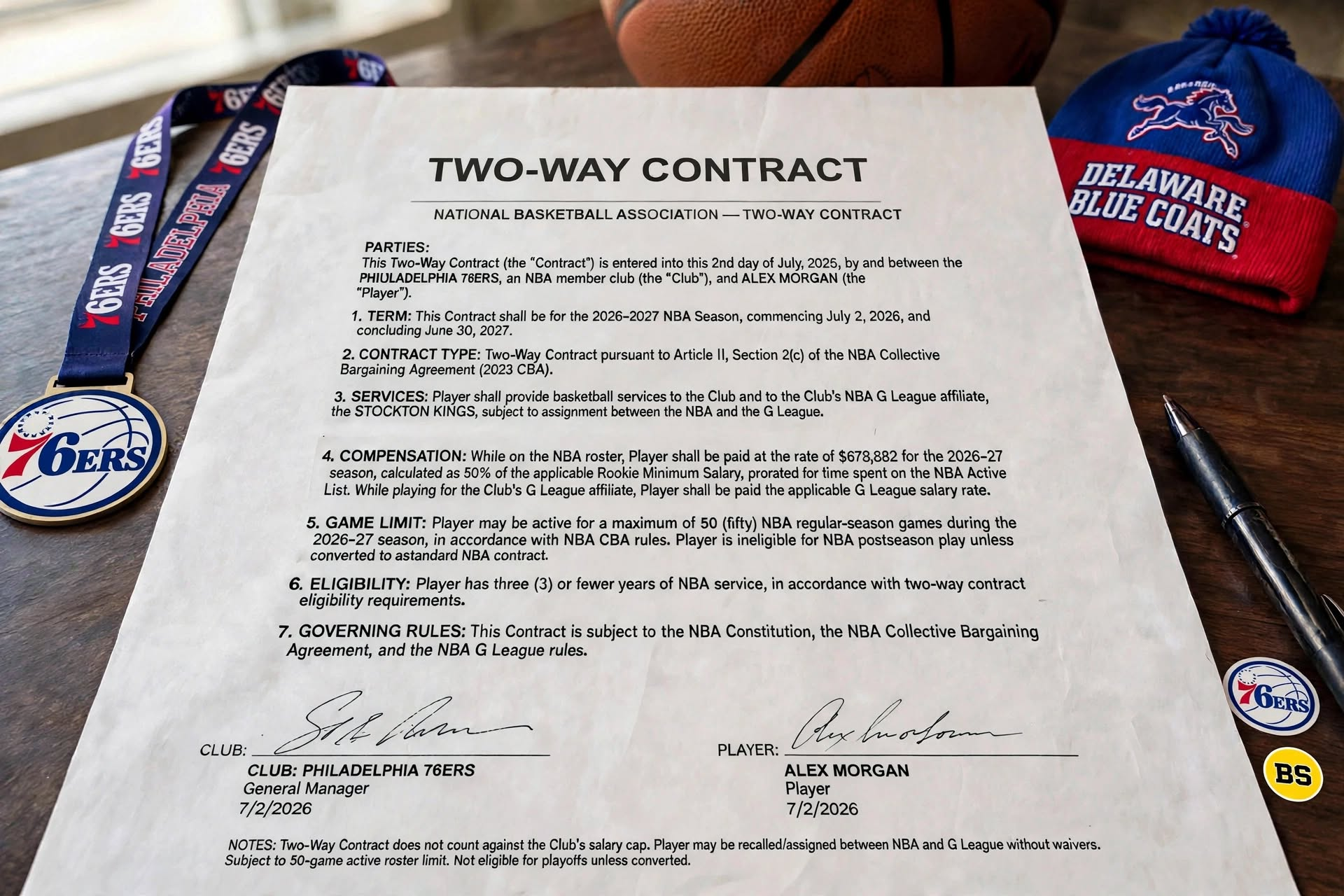
A two-way contract is an NBA contract that allows a player to spend time with both an NBA team and its NBA G League affiliate. It gives teams an opportunity to develop younger players while allowing those players to gain experience at both levels of professional basketball.
Two-way players are technically NBA players under contract with their NBA team. However, they generally spend much of the season playing in the G League and can be available to their NBA team when needed.
For the 2026-27 season, NBA teams can have up to three players on two-way contracts in addition to their maximum 15 players on standard NBA contracts.
What Does a Two-Way Contract Actually Do?

Let’s dive in a little deeper. The simplest way to understand a two-way contract is to think of it as a bridge between the NBA and the G League.
A player on a two-way contract is signed by an NBA team but can play for that team’s G League affiliate.
For example, imagine the Philadelphia 76ers signing a young guard to a two-way contract.
That player could:
- Practice and develop with the 76ers.
- Play games for the team’s G League affiliate.
- Be available to play for the 76ers when needed.
- Continue developing while getting significant playing time in the G League.
- Potentially earn a standard NBA contract if the team believes he is ready.
The NBA’s official rules define a two-way contract as an agreement under which a player provides services to both an NBA team and an NBA G League team.
Key Rules of a Two-Way Contract
1. Roster Capacity (Up to 3 Players)
NBA teams are allowed up to three two-way players at any given time, expanding total organizational roster size from 15 to 18.
2. The 50-Game Limit
A two-way player can be active for a maximum of 50 NBA regular-season games.
A game is counted against the 50-game limit the moment a two-way player is named to the team’s active game-day roster (the players permitted to suit up and play). So, playing time does not matter.
Once they hit that 50-game cap, the NBA team faces a choice: send them back to the G League for the rest of the season or convert their contract into a standard NBA deal.
If an NBA team is carrying fewer than 15 players on standard NBA contracts, all of that team’s two-way players are restricted to a combined, team-wide total of 90 active games until a 15th standard roster spot is filled.
3. Ineligible for the Postseason
Two-way players cannot play in the NBA Playoffs. If a team wants a two-way standout on their postseason roster, they must convert them to a standard 15-man NBA contract before the regular season ends.
4. Eligibility Restrictions
Not just anyone can sign a two-way deal. To be eligible, a player must have three or fewer years of NBA service time. That makes two-way contracts ideal for:
Undrafted free agents
Second-round draft picks
G League standouts looking for a call-up
International prospects transitioning to American basketball
Two-Way Salary and Salary Cap Impact
Unlike the NHL where “two-way” means a player gets paid drastically different daily rates depending on which league they play in, the NBA two-way contracts pay a flat, guaranteed rate.
For the 2026-2027 season a flat salary of $678,882 is paid to the player. This is exactly 50% of the standard minimum salary for a rookie in the NBA.
Two-way salaries are entirely excluded from the team’s salary cap and luxury tax calculations.
The Bystander Take
An NBA two-way contract is essentially a development pathway between the NBA and the G League.
It allows NBA teams to keep promising young players within their organization while giving those players opportunities to develop and play at both levels.
For the player, a two-way contract can be a stepping stone toward a full-time NBA career.
For the team, it provides another way to develop young talent and evaluate players before committing to a standard NBA roster spot.
So when you see that an NBA team has signed a player to a two-way contract, think of it as an NBA opportunity combined with a G League development role.
The player is part of the NBA organization, but his contract gives the team flexibility to develop him primarily through the G League while still giving him opportunities to contribute at the NBA level.
To learn more about the basics of basketball, read “NBA Basketball Basics: Game Structure, Scoring, Movement, Fouls and Defense“.
The Bystander

Leave a Reply