
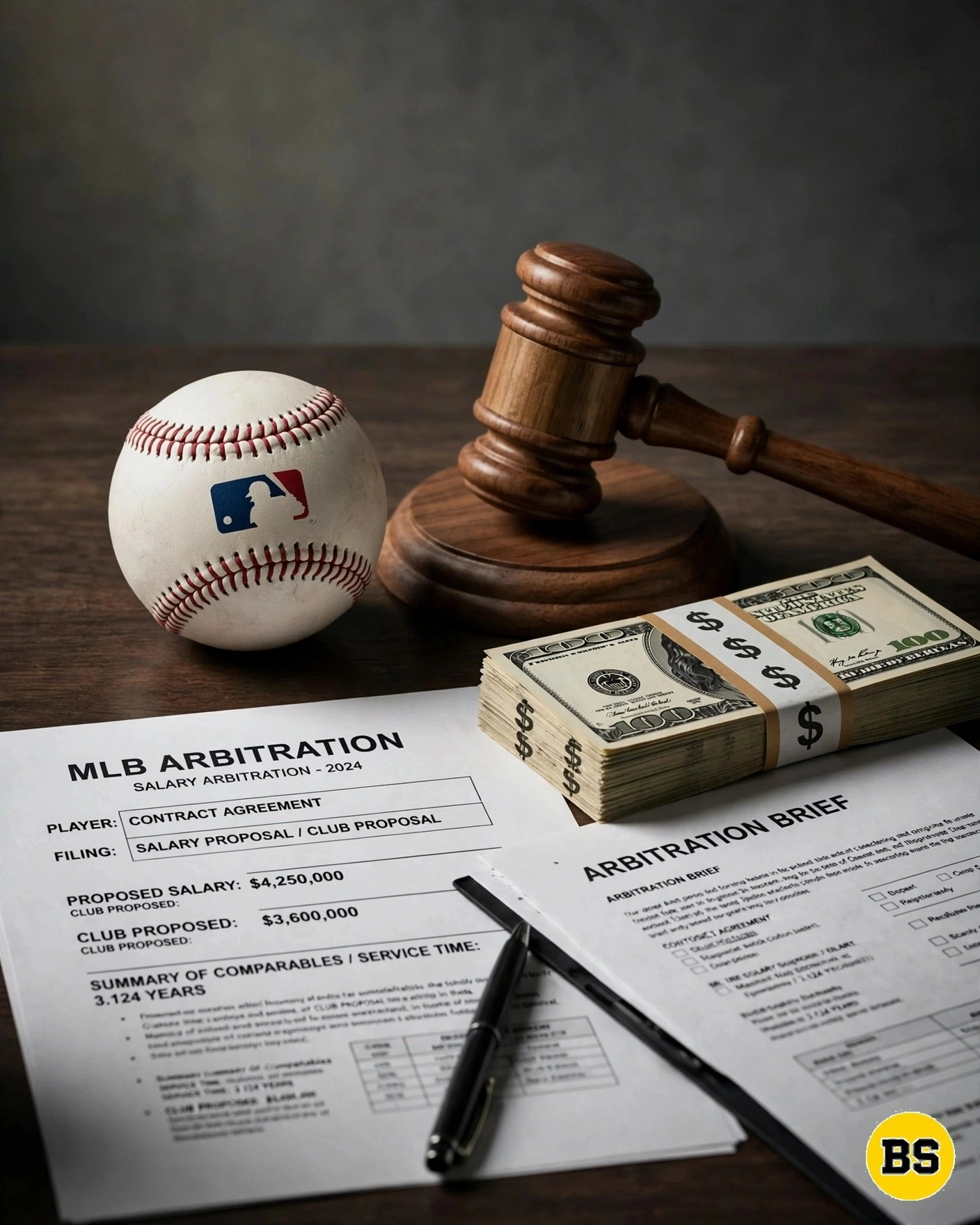

What Is MLB Salary Arbitration?
Whether you want to understand how front offices manage payroll or why your favorite team just traded away a productive starter. Here is your breakdown of Major League Baseball (MLB) arbitration.
Every winter, as the hot stove cools down and teams prepare for Spring Training, a specific high-stakes ritual takes center stage off the field: MLB Salary Arbitration.
To casual fans, hearing that a star player is “going to arbitration” sounds ominous like a bitter legal battle. Something that threatens to tear a team and player apart, and sometimes it is. But usually, it’s just the standard, fascinating business mechanism that bridges the gap between a rookie contract and full fledged free agency.
Major League Baseball salary arbitration is a process that helps determine how much an eligible player will earn for an upcoming season when the player and team cannot agree on a salary.
In simple terms, arbitration gives a player an opportunity to receive a raise based on his performance and experience, even if he and his team disagree about his value.
For example, imagine a young starting pitcher who wins 15 games, posts an impressive earned run average (ERA), and becomes one of his team’s most important players. The pitcher believes his contributions justify a significant salary increase, but the team believes his requested amount is too high.
If the two sides cannot negotiate an agreement, salary arbitration may determine the player’s salary.
The Importance of Arbitration to MLB
Arbitration is an important part of MLB’s economic system because it gives certain players more earning power before they become eligible for free agency. It also allows teams to retain control over eligible players without negotiating an entirely new contract from scratch.
Understanding arbitration helps explain why some players receive substantial raises. Why teams sometimes trade players before their salaries increase. And why contract negotiations can become complicated even when a player is performing well.
Who Qualifies?
There are two primary ways a player enters arbitration:
- Standard Eligibility (3–6 Years of Service): Once a player hits three years of service time, they qualify for arbitration for each remaining season until hitting six years.
- “Super Two” Status: A small subset of elite young players qualify a year early (after 2+ years of service). To qualify as a “Super Two,” a player must rank in the top 22% of service time among all players with between 2 and 3 years in the big leagues. This gives them four years of arbitration eligibility instead of three.
How Does MLB Salary Arbitration Work?
The timeline for arbitration moves quickly through the offseason:
Step 1: The Non-Tender Deadline (Late Fall)
Before negotiations begin, teams must decide whether to “tender” (offer) a contract to arbitration eligible players. If a team feels a player’s expected salary will outweigh their on-field value; they can non-tender them instantly making the player an unrestricted free agent.
Step 2: Exchanging Figures (Mid-January)
If a player is tendered a contract, both sides attempt to agree on a single-year salary. If no agreement is reached by the league deadline, both sides simultaneously submit a proposed salary figure to the league.
Step 3: Settling or Going to a Hearing (February)
Submitting figures doesn’t mean a hearing is guaranteed. Teams and players continue negotiating up until the trial like hearing. The vast majority of cases settle before reaching a panel.
If it goes to trial, a panel of three neutral arbitrators hears arguments from both sides and makes a binding decision.
4. The “File and Trial” Catch: Final Offer Arbitration
Unlike standard legal disputes where an arbitrator might split the difference down the middle, MLB uses baseball arbitration (or final offer arbitration).
The Rule: The panel cannot meet in the middle. They must pick either the player’s number or the team’s number.
Because there is no middle ground, both parties are incentivized to submit reasonable figures. Submitting an absurdly high or low number almost guarantees a loss.
What Evidence Is Allowed in a Hearing?
- Allowed: Onfield performance, health/availability, career trajectory, historical comparisons to players with similar service time, and team contribution.
- Banned: Team financial standings, media market size, non-baseball income, or public comments made about the player.
5. Why Teams Hate Going to Hearings
Many front offices operate under a “File and Trial” policy: if a player exchanges figures with the club, the team stops negotiating standard one year deals and forces a hearing.
Why avoid hearings? Because the process requires a team’s front office to sit in a room across from their star player and spend hours arguing why that player isn’t worth the money they’re asking for.
Telling a star pitcher that his ERA was inflated or that he struggles under pressure can damage working relationships. This complicate long-term contract extension talks down the road.
| Submitted Figure | Panel Decision | Resulting Salary |
| Player asks: $8.5M | Panel sides with Player | $8.5 Million |
| Team offers: $7.0M | Panel sides with Team | $7.0 Million |

The Bystander Take: Arbitration Is a Key Part of MLB’s Financial System
MLB salary arbitration provides a structured way to determine compensation for eligible players who have not yet reached free agency.
It gives players an opportunity to earn salaries that reflect their major league performance and experience, while allowing teams to retain control over those players under the league’s rules.
The process can involve negotiations, competing salary proposals, and formal hearings, although many cases are settled before a hearing takes place.
For a team such as the New York Mets, arbitration is an important part of planning for the future. Managing rising player salaries while building a competitive roster requires organizations to consider both on-field performance and long term financial commitments.
Ultimately, salary arbitration is one of the mechanisms that shape how MLB teams build their rosters, compensate their players, and prepare for the seasons ahead.
The next time you hear that a Mets player is arbitration eligible, you’ll know why that matters and why the outcome could have implications beyond one season’s salary.
Question: Should MLB teams try to sign their young stars to long term extensions before arbitration raises their salaries?
The Bystander
Closely Observing Arbitration for the MLB & Mets
Salary arbitration is one part of the larger relationship between MLB owners and players. The rules governing player compensation, free agency, and arbitration are influenced by the league’s collective bargaining agreement (CBA). This establishes many of the terms under which baseball operates. To understand the bigger picture, read our guide to the MLB Collective Bargaining Agreement and Its Biggest Disagreements.
Leave a Reply